
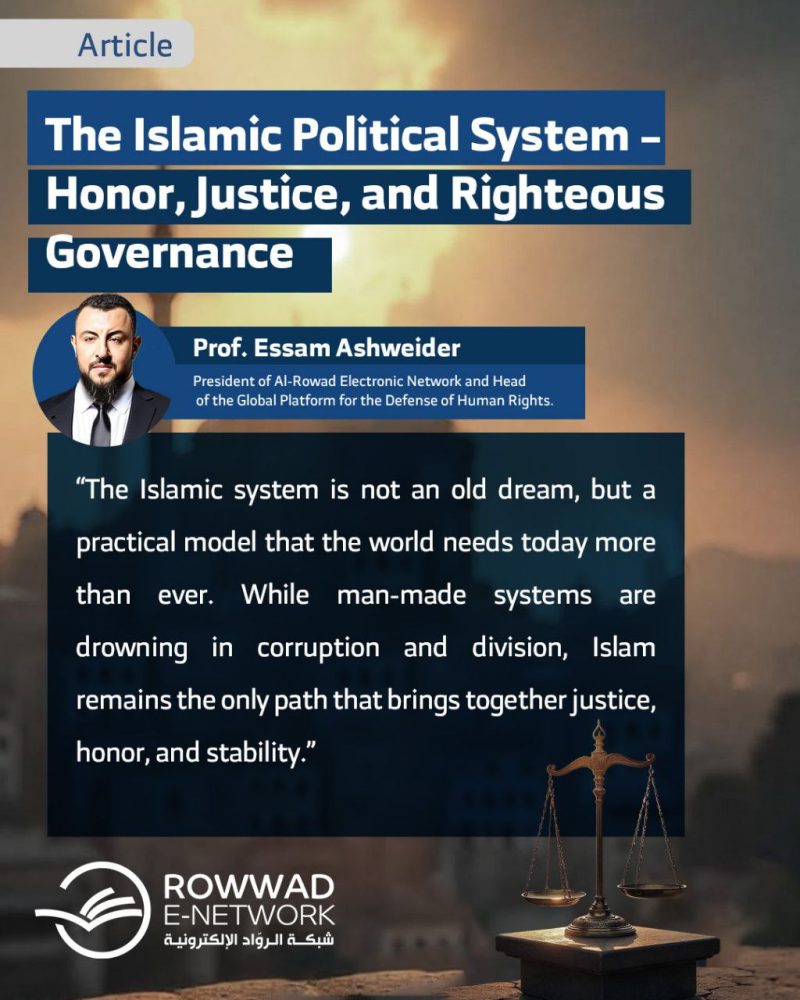
By Prof. Dr. Essam Ashwaider,
President of Al-Ruwad Electronic Network and Head of the Global Platform for Human Rights Defense
In the Name of Allah, the Most Gracious, the Most Merciful. Praise be to Allah, and peace and blessings be upon our Prophet Muhammad, his family, and companions.
Introduction:
When Umar ibn al-Khattab (may Allah be pleased with him) saw a man bowing his head humbly in prayer, he said to him, *"Do not weaken our religion for us!"* (Reported by Al-Bayhaqi in *Shu’ab al-Iman*). These words encapsulate the essence of Islamic governance, which came to liberate people from the darkness of ignorance, tyranny, and humiliation into the light of justice, freedom, and dignity—from the opportunistic, factional deep state to a just state that safeguards the rights of the nation and its people.
Umar ibn al-Khattab (may Allah be pleased with him) said, *"We are a people whom Allah has honored with Islam. Whoever seeks honor through anything other than it, Allah will humiliate him."* (Reported by Al-Hakim in *Al-Mustadrak*). This profound statement summarizes the philosophy of governance in Islam, which combines spiritual and material strength.
The Islamic political system is not merely an idealistic theory but a practical methodology that ensures security, stability, human dignity, and the eradication of corruption and class discrimination. How were these principles manifested in Islamic history? And what is the fundamental difference between them and modern political systems that claim democracy while drowning in corruption and division?
First: The Principles of Islamic Governance Between Justice and Dignity
1. Justice is the Foundation of Authority
Allah says:
"Indeed, Allah commands justice and good conduct." (Quran 16:90).
The Rightly Guided Caliphs applied this principle in practice:
- Umar ibn al-Khattab feared injustice under his rule, saying, *"If a mule stumbles in Iraq, I will be held accountable on the Day of Judgment: Why did you not pave the road for it, O Umar?!"* (Reported by Ibn Sa’d in *Al-Tabaqat*).
- Ali ibn Abi Talib advised his governor in Egypt, saying, *"People are either your brothers in faith or your equals in humanity."* (*Nahj al-Balagha*).
2. Rejection of Humiliation and Subjugation
- Islam forbids its followers from being humiliated, whether in worship or politics:
"But honor belongs to Allah, His Messenger, and the believers." (Quran 63:8).
- Umar’s stance with the Romans: *"We will not trade our religion for another."* (*Tarikh al-Tabari* 2/401).
- When some Christians asked Umar for permission to ring church bells in Medina, he refused, saying, *"We neither degrade ourselves nor humiliate Muslims."* (*Tarikh al-Tabari*).
- Material strength is a pillar of dignity: The Islamic system of jihad is not merely defensive but ensures strategic security. (Ibn al-Qayyim in *Zad al-Ma’ad* 3/5).
3. Equality Before the Law
- During Umar’s caliphate, he put Amr ibn al-As’s son on trial for striking an Egyptian Coptic man, declaring: *"Since when have you enslaved people when their mothers bore them free?"* (*Al-Bidayah wa al-Nihayah* by Ibn Kathir).
- This incident demonstrates that the Islamic system does not differentiate between rulers and subjects or between the rich and the poor.
Second: The Fundamental Differences Between Islamic Governance and Modern Systems
1. The Source of Legislation
- Islamic governance: Derives its laws from divine revelation (Quran and Sunnah), which does not change with shifting desires.
- Modern systems: Rely on man-made laws that change according to the interests of ruling elites.
2. The Criteria for Leadership Appointments
- Islamic governance: Prioritizes competence and piety. Umar once said about Salim, the freed slave of Abu Hudhayfah, *"Whoever wishes to see a man from the people of Paradise, let him look at this man,"* before appointing him to a position.
- Modern systems: Favor nepotism and partisan loyalty over merit.
3. Handling Public Funds
- Islamic governance: Considers public wealth a trust. Umar would say, *"Hold yourselves accountable before you are held accountable."*
- Modern systems: Are plagued by embezzlement and shady deals under legal cover.
4. Rights of Minorities
- Islamic governance: Protects their rights without discrimination, as seen in the Prophet’s (ﷺ) covenant with the Jews of Medina (though they later betrayed it). It safeguards rights without diluting identity (Al-Mawardi in *Al-Ahkam al-Sultaniyyah*, p. 179).
- Modern systems: Exploit minorities as political leverage.
Third: Contemporary Examples Showcasing the Superiority of the Islamic System
1. Malaysia: The Islamic Economic Model
- Achieved remarkable economic growth through Islamic finance, while resource-rich nations like Venezuela collapsed due to corruption.
2. Sudan During Omar al-Bashir’s Era
- Despite criticism, Sudan maintained long-term stability under Sharia, while neighboring nations suffered chaos.
3. Afghanistan: Independent Foreign Policy
- Its adherence to Islamic principles in politics enabled it to resist international pressures, unlike other Muslim nations that follow foreign agendas.
Conclusion: Islam is the Practical Solution
The Islamic system is not an ancient dream but a viable model that the world needs today more than ever. While man-made systems drown in corruption and division, Islam remains the only methodology that combines justice, dignity, and stability.
The path to true dignity begins with adherence to Islam as a creed, law, and way of life. As Umar said, *"There is no honor except through Islam."* (*Al-Mustadrak* 4/98). This is what history has proven and what the early Muslims achieved.


اكتب مراجعة عامة